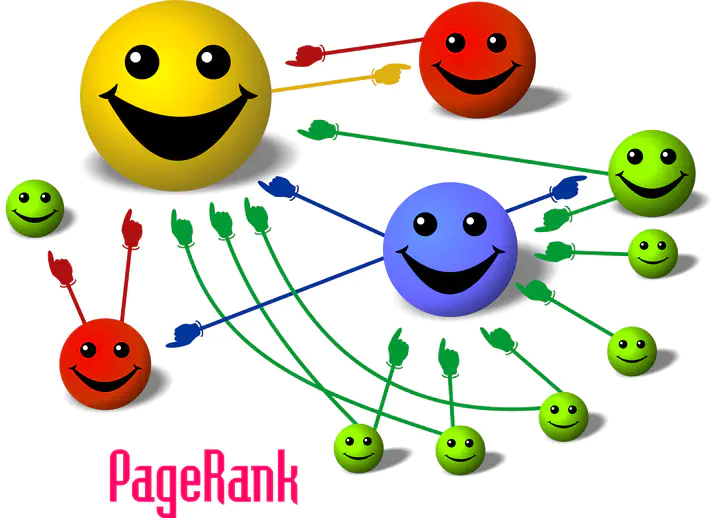
PageRank is a measure of web page quality based on the structure of the hyperlink graph. Although it is only one of thousands of features that is taken into account in Google’s search algorithm, it is perhaps one of the best known and most studied.
A vivid way to illustrate PageRank is to imagine a random web surfer: the surfer visits a page, randomly clicks a link on that page, and repeats ad infinitum. PageRank is a measure of how frequently a page would be encountered by our tireless web surfer. More precisely, PageRank is a probability distribution over nodes in the graph representing the likelihood that a random walk over the link structure will arrive at a particular node. Nodes that have high in- degrees tend to have high PageRank values, as well as nodes that are linked to by other nodes with high PageRank values. This behavior makes intuitive sense: if PageRank is a measure of page quality, we would expect high-quality pages to contain “endorsements” from many other pages in the form of hyperlinks. Similarly, if a high-quality page links to another page, then the second page is likely to be high quality also.
The complete formulation of PageRank includes an additional component. As it turns out, our web surfer doesn’t just randomly click links. Before the surfer decides where to go next, a biased coin is flipped—heads, the surfer clicks on a random link on the page as usual. Tails, however, the surfer ignores the links on the page and randomly “jumps” or “teleports” to a completely different page.
The fact that PageRank is recursively defined translates into an iterative algorithm which is quite similar in basic structure to parallel breadth-first search. The inputs to the program are pages from the Simple English Wikipedia. You must compute the “importance” of various Wikipedia pages/articles as determined by the PageRank metric, and present them in decreasing order of importance. We will be using a pre-processed version of the Simple Wikipedia corpus in which the pages are stored in an XML format.

Federica Baldi
Computer Engineer with a major in Artificial Intelligence and Data Engineering
My research interests include Computer Vision, NLP, and Artificial Intelligence for Healthcare and Society.